Spine anatomy in 3D
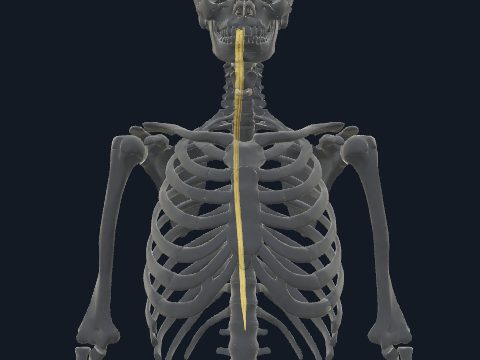
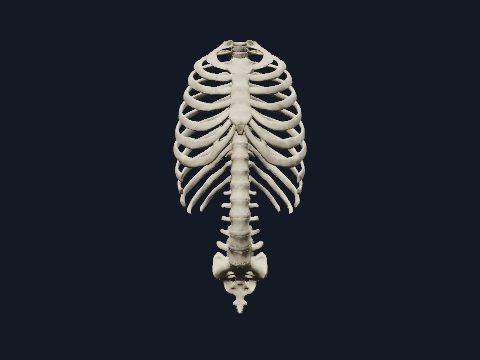
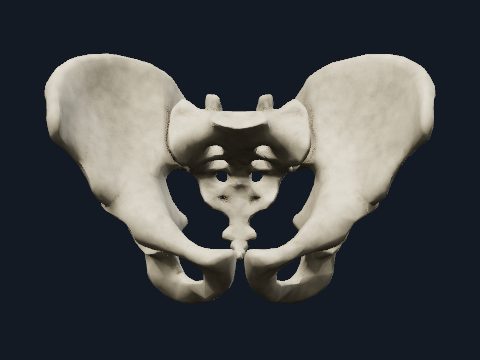
The spine, or vertebral column, is the flexible stack of vertebrae and intervertebral discs that runs from the skull to the pelvis, carries the weight of the trunk and encloses the spinal cord. In this free 3D model you can rotate the column, isolate any single vertebra or disc and compare the cervical, thoracic and lumbar regions side by side.
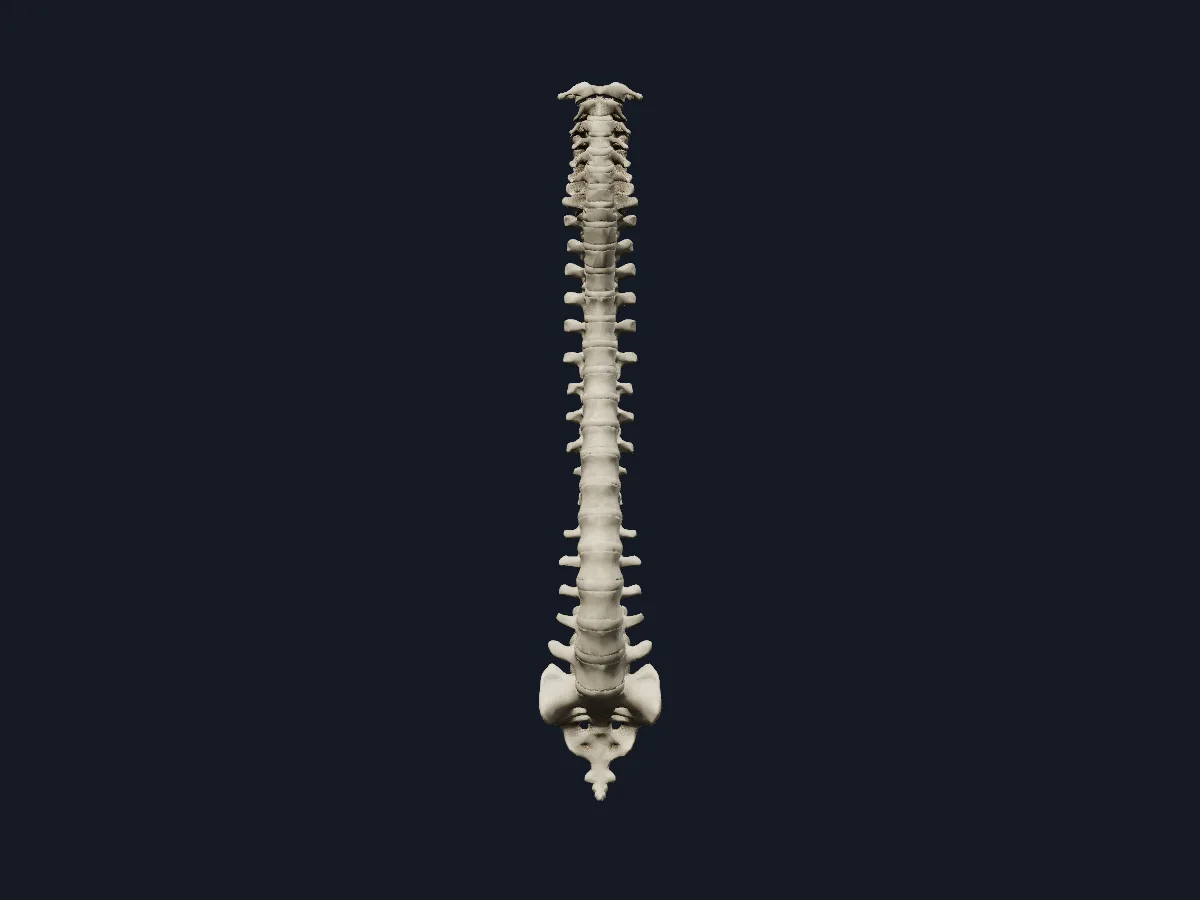 Image: Cogni Anatomy · CC BY 4.0 · Sources: BodyParts3D
- 33 vertebrae: 7 cervical, 12 thoracic, 5 lumbar, 5 fused sacral and 4 coccygeal (variable)
- 4 curvatures in adults: cervical and lumbar lordosis, thoracic and sacral kyphosis
- No intervertebral disc between the atlas (C1) and the axis (C2)
- Intervertebral discs make up roughly a quarter of the length of the column above the sacrum
- In adults the spinal cord usually ends at about the L1–L2 level
Structure of the vertebral column
A typical vertebra has a body in front and a vertebral arch behind, made of two pedicles and two laminae. The arch carries a spinous process, two transverse processes and four articular processes. Body and arch enclose the vertebral foramen, and the stacked foramina form the vertebral canal for the spinal cord.
Each region has its own features: cervical vertebrae have a foramen in each transverse process, thoracic vertebrae have facets for the ribs, and lumbar vertebrae have large kidney-shaped bodies. The atlas has no body, and the axis carries the dens. Between the bodies lie discs of annulus fibrosus around a nucleus pulposus.
What the 3D model shows
The vertebral column view contains 48 separate parts: the atlas, the axis and the vertebrae C3–C7, all twelve thoracic and five lumbar vertebrae, the sacrum, and the 23 intervertebral discs from C2–C3 down to L5–S1. Every vertebra and disc is its own named piece, so you can click, hide or isolate it. The coccyx is not part of this view. The explode slider pulls the vertebrae and discs apart along the column.
How to study the spine
Begin with the lateral view to see the four curvatures and how the bodies grow larger from the neck to the lower back. Isolate one vertebra from each region, for example C5, T6 and L3, and compare the body, the spinous process and the transverse processes. Turn to the superior view of the atlas and axis to see how the dens sits in the ring of C1. Then explode the column, hide the labels and name each vertebra from C1 to L5 from memory, together with one feature that identifies its region.
What is in this model
48 3D parts. Names follow the Foundational Model of Anatomy (FMA).
- Bones 48
- Atlas
- Axis
- Eighth thoracic vertebra
- Eleventh thoracic vertebra
- Fifth cervical vertebra
- Fifth lumbar vertebra
- Fifth thoracic vertebra
- First lumbar vertebra
- First thoracic vertebra
- Fourth cervical vertebra
- Fourth lumbar vertebra
- Fourth thoracic vertebra
- Intervertebral disk
- Intervertebral disk of axis
- Intervertebral disk of eighth thoracic vertebra
- Intervertebral disk of eleventh thoracic vertebra
- Intervertebral disk of fifth cervical vertebra
- Intervertebral disk of fifth lumbar vertebra
- Intervertebral disk of fifth thoracic vertebra
- Intervertebral disk of first lumbar vertebra
- Intervertebral disk of first thoracic vertebra
- Intervertebral disk of fourth cervical vertebra
- Intervertebral disk of fourth lumbar vertebra
- Intervertebral disk of fourth thoracic vertebra
- Intervertebral disk of ninth thoracic vertebra
- Intervertebral disk of second lumbar vertebra
- Intervertebral disk of second thoracic vertebra
- Intervertebral disk of seventh cervical vertebra
- Intervertebral disk of seventh thoracic vertebra
- Intervertebral disk of sixth cervical vertebra
- Intervertebral disk of sixth thoracic vertebra
- Intervertebral disk of tenth thoracic vertebra
- Intervertebral disk of third cervical vertebra
- Intervertebral disk of third lumbar vertebra
- Intervertebral disk of third thoracic vertebra
- Ninth thoracic vertebra
- Sacrum
- Second lumbar vertebra
- Second thoracic vertebra
- Seventh cervical vertebra
- and 8 more
Questions
How many vertebrae are in the human spine?
Usually 33: 7 cervical, 12 thoracic and 5 lumbar vertebrae, 5 sacral vertebrae fused into the sacrum and about 4 coccygeal vertebrae fused into the coccyx. The number of coccygeal vertebrae varies between people.
What is between the vertebrae?
Intervertebral discs join the vertebral bodies from C2–C3 down to L5–S1. Each disc has a tough outer ring, the annulus fibrosus, around a gel-like core, the nucleus pulposus. Behind the bodies, neighbouring vertebrae also meet at paired facet joints.
What are the regions of the spine?
From top to bottom: cervical (neck), thoracic (chest), lumbar (lower back), sacral and coccygeal. The cervical and lumbar regions curve forward, the thoracic and sacral regions curve backward.