Trunk bones in 3D
The bones of the trunk are the thoracic and lumbar vertebrae, the sacrum, twelve pairs of ribs with their costal cartilages and the sternum. The ribs, thoracic vertebrae and sternum together form the thoracic cage, which protects the heart and lungs and moves with every breath. In this free 3D model you can turn the cage around, isolate single ribs and see where each rib meets the spine and the sternum.
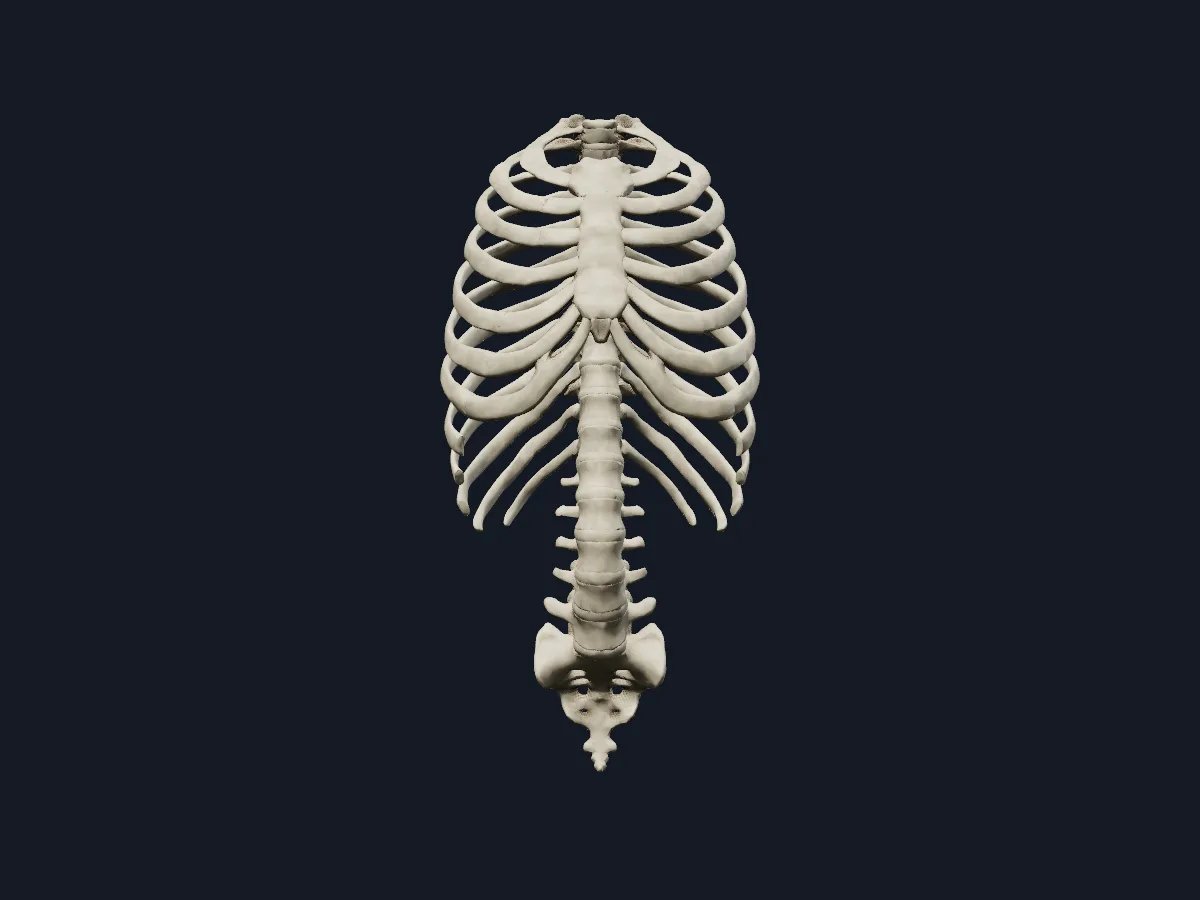 Image: Cogni Anatomy · CC BY 4.0 · Sources: BodyParts3D
- 12 pairs of ribs: 7 true (1–7), 3 false (8–10) and 2 floating (11–12)
- The sternum has 3 parts: manubrium, body and xiphoid process
- The sternal angle, between manubrium and body, lies at the level of the second costal cartilage
- A typical rib head articulates with its own vertebra and the one above; its tubercle meets the transverse process of its own vertebra
- The first rib is the shortest, broadest and most curved rib
Structure of the trunk skeleton
Behind, the thoracic vertebrae carry the ribs, and below them the lumbar vertebrae and the sacrum take the weight of the upper body down to the pelvis. Each rib curves forward from the spine and continues as a costal cartilage. The first seven cartilages reach the sternum directly; ribs 8–10 join the cartilage above, and ribs 11 and 12 end free in the abdominal wall.
The sternum is a flat bone in the midline of the chest. The manubrium joins the clavicles and the first ribs, the body takes the cartilages of ribs 2–7, and the small xiphoid process points down towards the abdomen.
What the 3D model shows
The trunk bones view has 77 parts: thoracic vertebrae T1–T12, lumbar vertebrae L1–L5, the sacrum and the intervertebral discs from C7–T1 to L5–S1; the left and right ribs 1–12; the costal cartilages of the first seven ribs; and the manubrium, body and xiphoid process of the sternum. Each rib, cartilage and vertebra is a separate part you can select, hide or isolate. The cervical vertebrae, shoulder girdle and hip bones belong to other views.
How to study the trunk bones
In the anterior view find the sternal angle and count the ribs downwards from the second costal cartilage, the way it is done on the living chest. Turn to the posterior view and follow a single rib from its head on the vertebral bodies to its tubercle on the transverse process. Isolate the first, seventh, eleventh and twelfth ribs to compare their shapes. Then hide everything except the sternum and the cartilages, and recall from memory which ribs are true, false and floating.
What is in this model
77 3D parts. Names follow the Foundational Model of Anatomy (FMA).
- Bones 77
- Body of sternum
- Eighth rib
- Eighth thoracic vertebra
- Eleventh rib
- Eleventh thoracic vertebra
- Fifth costal cartilage
- Fifth lumbar vertebra
- Fifth rib
- Fifth thoracic vertebra
- First costal cartilage
- First lumbar vertebra
- First rib
- First thoracic vertebra
- Fourth costal cartilage
- Fourth lumbar vertebra
- Fourth rib
- Fourth thoracic vertebra
- Intervertebral disk
- Intervertebral disk of eighth thoracic vertebra
- Intervertebral disk of eleventh thoracic vertebra
- Intervertebral disk of fifth lumbar vertebra
- Intervertebral disk of fifth thoracic vertebra
- Intervertebral disk of first lumbar vertebra
- Intervertebral disk of first thoracic vertebra
- Intervertebral disk of fourth lumbar vertebra
- Intervertebral disk of fourth thoracic vertebra
- Intervertebral disk of ninth thoracic vertebra
- Intervertebral disk of second lumbar vertebra
- Intervertebral disk of second thoracic vertebra
- Intervertebral disk of seventh cervical vertebra
- Intervertebral disk of seventh thoracic vertebra
- Intervertebral disk of sixth thoracic vertebra
- Intervertebral disk of tenth thoracic vertebra
- Intervertebral disk of third lumbar vertebra
- Intervertebral disk of third thoracic vertebra
- Manubrium
- Ninth rib
- Ninth thoracic vertebra
- Sacrum
- Second costal cartilage
- and 18 more
Questions
How many ribs do humans have?
Usually 24, in 12 pairs. Each pair attaches to one of the twelve thoracic vertebrae.
What are true, false and floating ribs?
True ribs (1–7) reach the sternum through their own costal cartilages. False ribs (8–10) join the cartilage of the rib above. Floating ribs (11 and 12) have no anterior attachment to the sternum or other cartilages.
What are the parts of the sternum?
The manubrium at the top, the body in the middle and the xiphoid process at the bottom. The manubrium and body meet at the sternal angle, a landmark for the second rib.