The human skeleton in 3D
The human skeleton is the framework of 206 bones in the adult body, divided into the axial skeleton (skull, vertebral column, ribs and sternum) and the appendicular skeleton (the limbs and the girdles that attach them). It supports and protects the body, gives the muscles levers to pull on and houses the bone marrow. In this free 3D model you can rotate the whole skeleton, take it apart and look up any bone by name.
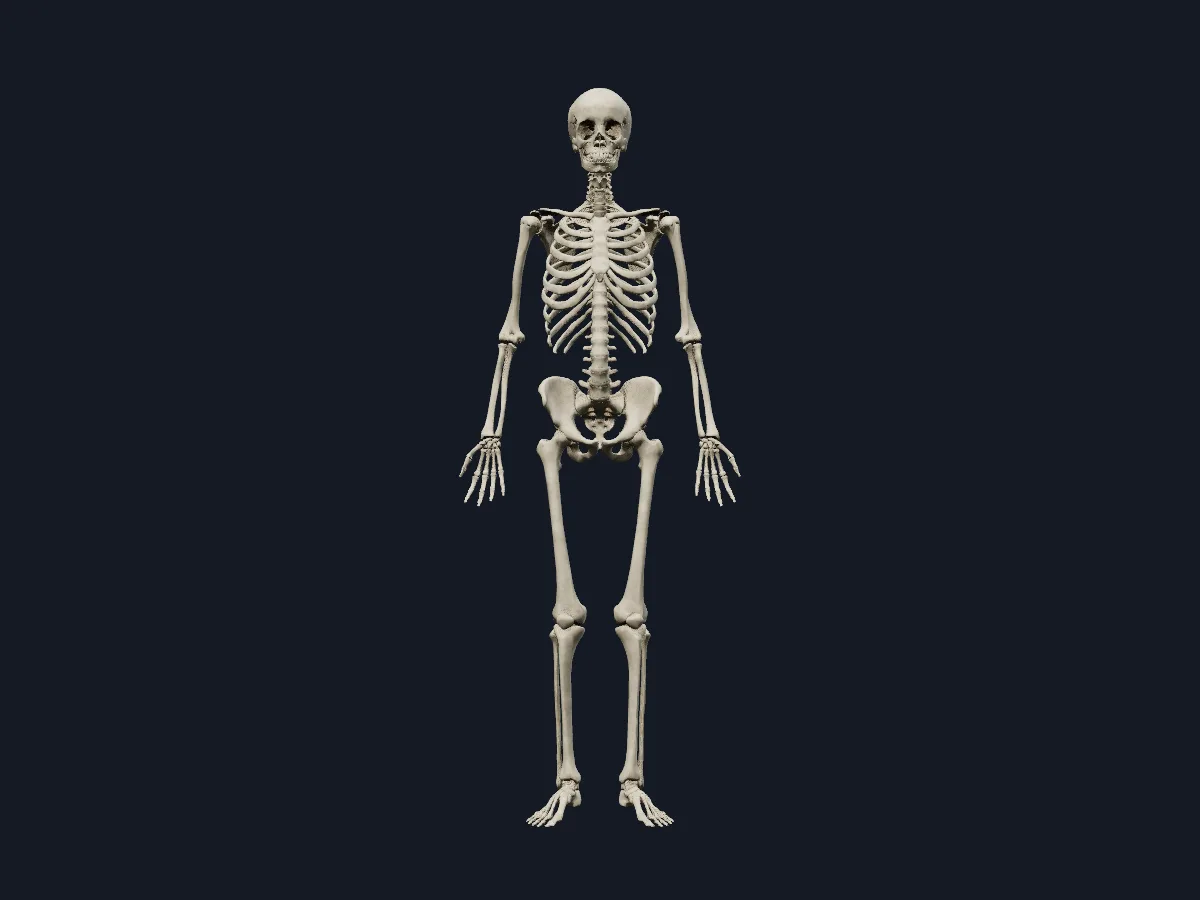 Image: Cogni Anatomy · CC BY 4.0 · Sources: BodyParts3D
- 206 bones in the adult skeleton: 80 axial and 126 appendicular
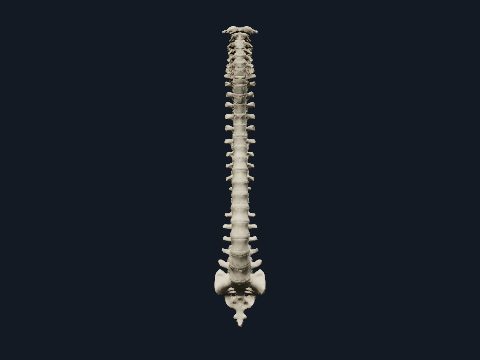
- 33 vertebrae: 7 cervical, 12 thoracic, 5 lumbar, 5 fused sacral and about 4 coccygeal
- 12 pairs of ribs: 7 true, 3 false and 2 floating
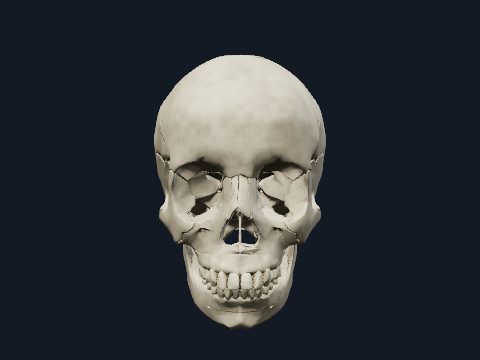
- 22 bones in the skull: 8 cranial and 14 facial
- The femur is the longest bone; the stapes in the middle ear is the smallest
Parts of the skeleton
The axial skeleton has 80 bones: the skull with the ossicles of the ear, the hyoid bone, the vertebral column, the ribs and the sternum. It protects the brain, spinal cord, heart and lungs. The appendicular skeleton has 126 bones: the clavicles and scapulae of the shoulder girdle, the bones of the arms and hands, the hip bones and the bones of the legs and feet.
Bones meet at joints of different types: fibrous sutures in the skull, cartilaginous joints such as the intervertebral discs and the pubic symphysis, and freely movable synovial joints such as the shoulder, hip and knee.
What the 3D model shows
The model shows the skeleton of the whole body on both sides: the bones of the cranium and face with the mandible and teeth, the hyoid bone and the cartilages of the larynx, the cervical, thoracic and lumbar vertebrae with their intervertebral discs, the sacrum, the twelve pairs of ribs with their costal cartilages, the manubrium, body and xiphoid process of the sternum, and the bones of both arms and legs down to the phalanges. Some bones and cartilages are split into several parts, so the viewer's part count is higher than the 206-bone total.
How to study the skeleton
Start in the anterior view and divide the skeleton into its axial and appendicular parts. Isolate the vertebral column and turn to the lateral view, where the cervical and lumbar curves are visible, and count the vertebrae of each region. Then explode the skeleton into separate pieces and reassemble one region at a time: skull, thorax, pelvis, limbs. Search a bone by name when you cannot place it. Testing yourself on one region a day and returning to it a few days later builds lasting recall.
What is in this model
280 3D parts. Names follow the Foundational Model of Anatomy (FMA).
- Bones 280
- Arytenoid cartilage
- Atlas
- Axis
- Body of sternum
- Calcaneus
- Capitate
- Clavicle
- Corniculate cartilage
- Cricoid cartilage
- Cuboid bone
- Cuneiform cartilage
- Distal phalanx of left big toe
- Distal phalanx of left fourth toe
- Distal phalanx of left index finger
- Distal phalanx of left little finger
- Distal phalanx of left little toe
- Distal phalanx of left middle finger
- Distal phalanx of left ring finger
- Distal phalanx of left second toe
- Distal phalanx of left third toe
- Distal phalanx of left thumb
- Distal phalanx of right big toe
- Distal phalanx of right fourth toe
- Distal phalanx of right index finger
- Distal phalanx of right little finger
- Distal phalanx of right little toe
- Distal phalanx of right middle finger
- Distal phalanx of right ring finger
- Distal phalanx of right second toe
- Distal phalanx of right third toe
- Distal phalanx of right thumb
- Eighth rib
- Eighth thoracic vertebra
- Eleventh rib
- Eleventh thoracic vertebra
- Ethmoid
- Femur
- Fibula
- Fifth cervical vertebra
- Fifth costal cartilage
- and 159 more
Questions
How many bones are in the human body?
An adult has 206 bones. A newborn has more separate bony parts, because bones such as the sacrum and the hip bones begin as several pieces that fuse during growth.
What is the largest bone in the human body?
The femur (thigh bone) is the longest and heaviest bone. The smallest is the stapes, one of the three ossicles of the middle ear.
What are the main functions of the skeleton?
It supports the body, protects internal organs, provides levers for the muscles, stores calcium and phosphate, and produces blood cells in the red bone marrow.