Bones of the arm in 3D
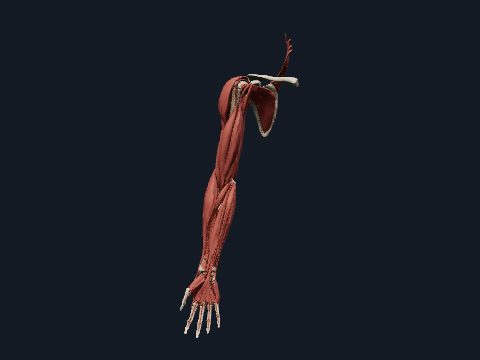
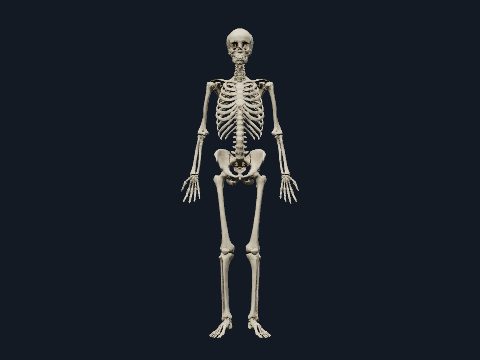
The bones of the arm (upper limb) are the clavicle and scapula of the shoulder girdle, the humerus of the upper arm, the radius and ulna of the forearm, and the 27 bones of the hand. Together they form the shoulder, elbow and wrist joints that place the hand where it is needed. In this free 3D model you can rotate the right upper limb, isolate any bone and see how the two forearm bones lie side by side.
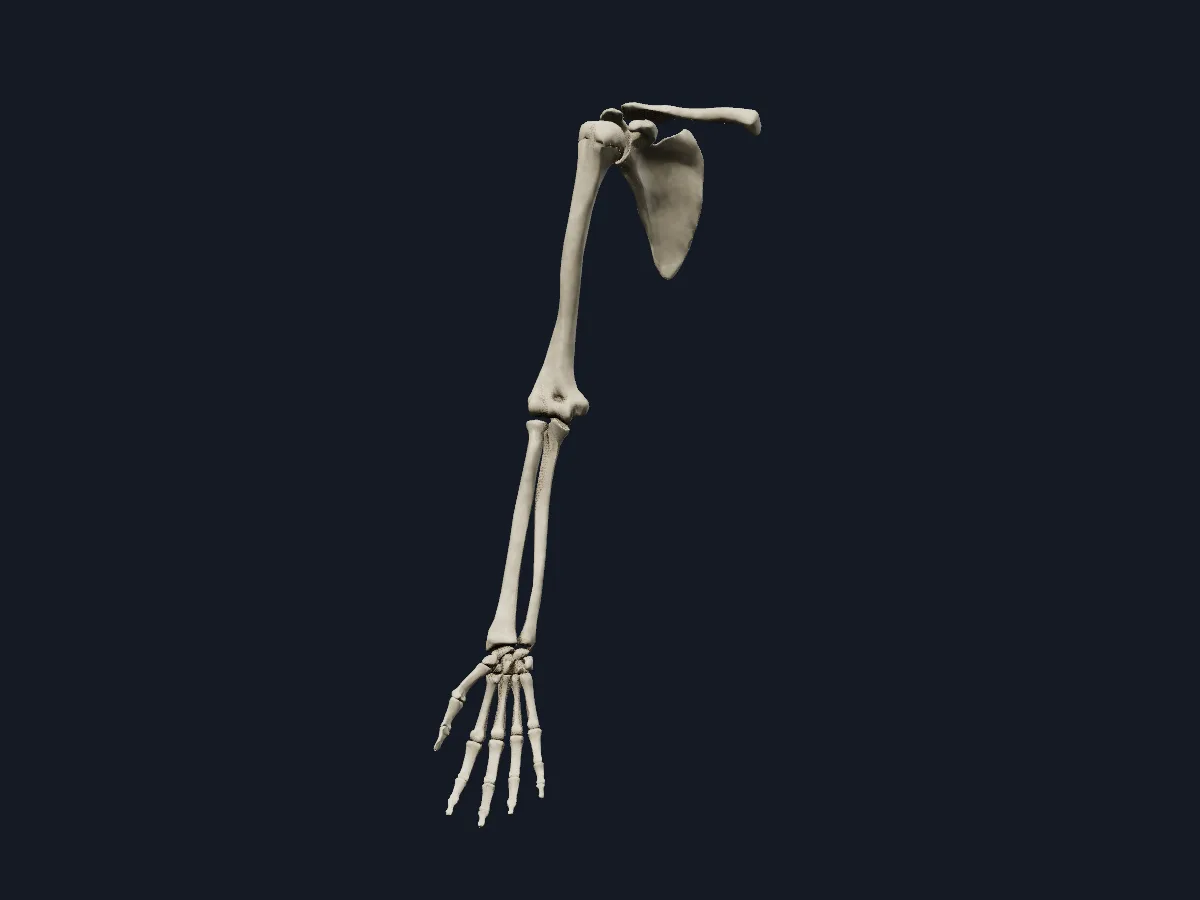 Image: Cogni Anatomy · CC BY 4.0 · Sources: BodyParts3D
- 32 bones in each upper limb, counting the clavicle and scapula
- The humerus is the longest and largest bone of the upper limb
- The radius lies on the thumb side of the forearm, the ulna on the little-finger side
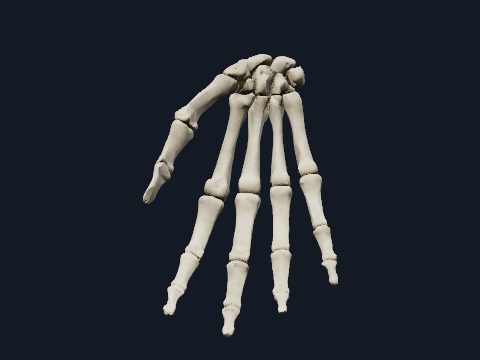
- 27 bones in each hand: 8 carpals, 5 metacarpals and 14 phalanges
- The clavicle is the only bony link between the upper limb and the trunk
Structure of the upper limb skeleton
The scapula and clavicle form the shoulder girdle. The head of the humerus fits the shallow glenoid cavity of the scapula, so the shoulder joint trades stability for a wide range of movement. At the elbow the trochlea of the humerus articulates with the trochlear notch of the ulna, and the capitulum with the head of the radius.
The radius and ulna are joined along their length by the interosseous membrane and meet at the proximal and distal radio-ulnar joints. In pronation the radius rotates and crosses over the ulna. At the wrist it is the radius, not the ulna, that articulates with the scaphoid and lunate.
What the 3D model shows
The model shows the bones of the right upper limb: clavicle, scapula, humerus, radius and ulna, the eight carpal bones, the five metacarpals and the phalanges of the thumb and four fingers. The bones appear without muscles or vessels, so the joint surfaces at the shoulder, elbow and wrist are in clear view. The explode slider pulls the bones apart to show each articular surface and puts them back together again.
How to study the arm bones
Start in the anterior view: find the humerus, then the radius on the lateral (thumb) side and the ulna on the medial side. Turn to the posterior view to see the olecranon of the ulna and the spine of the scapula. Isolate the humerus and rotate it to follow the head, surgical neck, shaft and the medial and lateral epicondyles. Then close the model, list the bones from shoulder to fingertips from memory and check each one with the search.
What is in this model
32 3D parts. Names follow the Foundational Model of Anatomy (FMA).
- Bones 32
- Capitate
- Clavicle
- Distal phalanx of right index finger
- Distal phalanx of right little finger
- Distal phalanx of right middle finger
- Distal phalanx of right ring finger
- Distal phalanx of right thumb
- Fifth metacarpal bone
- First metacarpal bone
- Fourth metacarpal bone
- Hamate
- Humerus
- Lunate
- Middle phalanx of right index finger
- Middle phalanx of right little finger
- Middle phalanx of right middle finger
- Middle phalanx of right ring finger
- Pisiform
- Proximal phalanx of right index finger
- Proximal phalanx of right little finger
- Proximal phalanx of right middle finger
- Proximal phalanx of right ring finger
- Proximal phalanx of right thumb
- Radius
- Scaphoid
- Scapula
- Second metacarpal bone
- Third metacarpal bone
- Trapezium
- Trapezoid
- Triquetral
- Ulna
Questions
How many bones are in the arm?
Each upper limb has 32 bones: the clavicle, scapula, humerus, radius, ulna, 8 carpals, 5 metacarpals and 14 phalanges. In the strict anatomical sense, the arm between shoulder and elbow contains only one bone, the humerus.
What is the difference between the radius and the ulna?
Both are forearm bones. The radius lies on the thumb side and is widest at the wrist, where it forms most of the wrist joint; the ulna lies on the little-finger side and is widest at the elbow, where its olecranon forms the point of the elbow.