Bones of the hand in 3D
The hand skeleton has 27 bones in three groups: 8 carpal bones in the wrist, 5 metacarpals in the palm and 14 phalanges in the thumb and fingers. Their many small joints let the hand grip with force and handle objects with precision. In this free 3D model you can rotate the right hand, separate its bones and learn them by name.
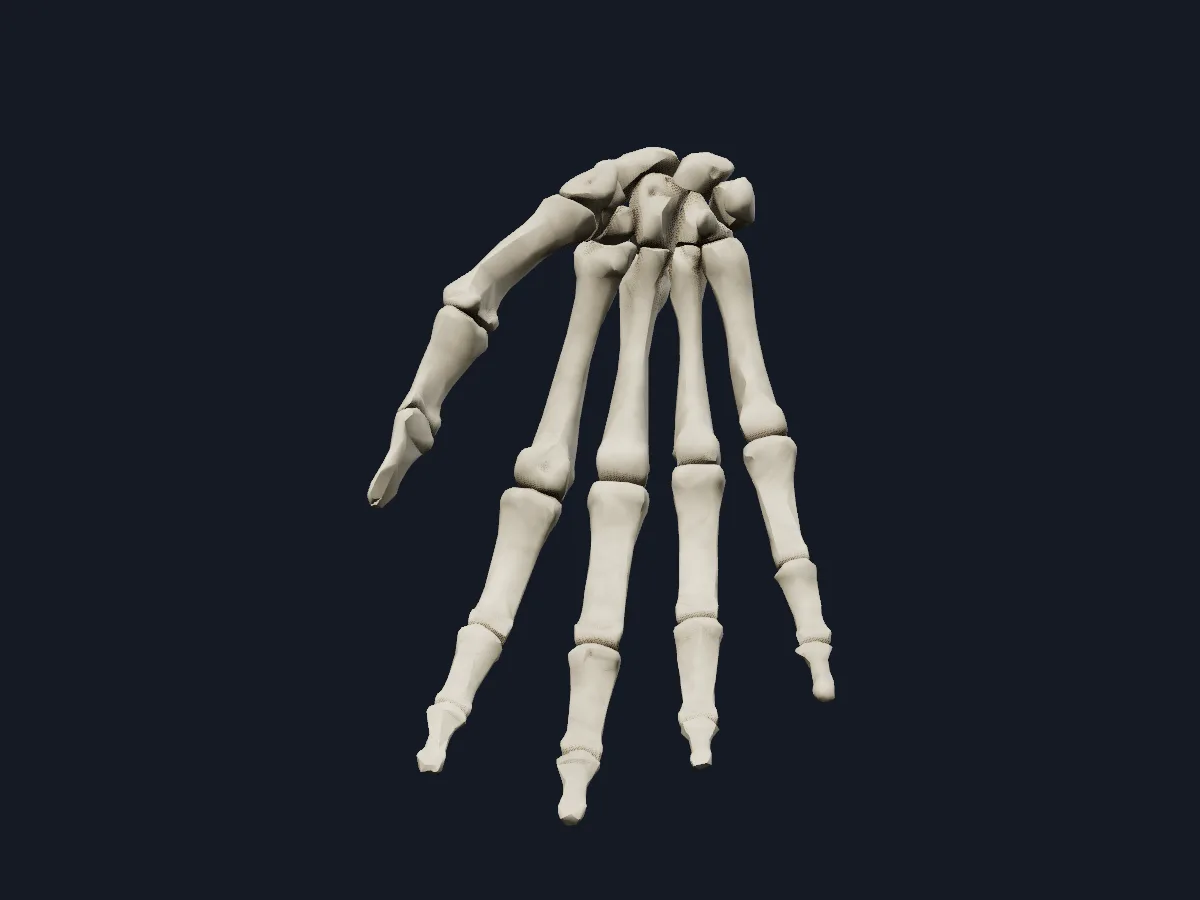 Image: Cogni Anatomy · CC BY 4.0 · Sources: BodyParts3D
- 27 bones in each hand: 8 carpals, 5 metacarpals and 14 phalanges
- Proximal carpal row: scaphoid, lunate, triquetrum, pisiform; distal row: trapezium, trapezoid, capitate, hamate
- The thumb has 2 phalanges; each finger has 3
- The capitate is the largest carpal bone
- The pisiform is a sesamoid bone in the tendon of flexor carpi ulnaris
Structure of the hand skeleton
The carpal bones sit in two rows. The proximal row, mainly the scaphoid and lunate, articulates with the radius at the wrist joint; the distal row articulates with the bases of the metacarpals. The carpus forms an arch, and the flexor retinaculum spans it to close the carpal tunnel.
The first metacarpal meets the trapezium at a saddle-shaped carpometacarpal joint, which lets the thumb oppose the fingers. The heads of the metacarpals form the knuckles. Each finger has a proximal, middle and distal phalanx; the thumb has only a proximal and a distal one.
What the 3D model shows
The model shows the bones of the right hand on their own: the scaphoid, lunate, triquetrum, pisiform, trapezium, trapezoid, capitate and hamate in the wrist, the five metacarpals, and the proximal, middle and distal phalanges of the thumb and fingers. With no muscles or tendons in the way, you can see the joint surfaces between the carpal bones and at the bases of the metacarpals. The explode slider separates every piece so you can examine each bone from all sides.
How to study the hand bones
Work from the palmar (anterior) view. Name the proximal carpal row from the thumb side: scaphoid, lunate, triquetrum, pisiform. Then move to the distal row and finish with the hamate and its hook. Number the metacarpals from the thumb (first) to the little finger (fifth) and count the phalanges finger by finger. Then explode the hand, pick single bones and identify them without their neighbours, the way bones are often tested in practical exams.
What is in this model
27 3D parts. Names follow the Foundational Model of Anatomy (FMA).
- Bones 27
- Capitate
- Distal phalanx of right index finger
- Distal phalanx of right little finger
- Distal phalanx of right middle finger
- Distal phalanx of right ring finger
- Distal phalanx of right thumb
- Fifth metacarpal bone
- First metacarpal bone
- Fourth metacarpal bone
- Hamate
- Lunate
- Middle phalanx of right index finger
- Middle phalanx of right little finger
- Middle phalanx of right middle finger
- Middle phalanx of right ring finger
- Pisiform
- Proximal phalanx of right index finger
- Proximal phalanx of right little finger
- Proximal phalanx of right middle finger
- Proximal phalanx of right ring finger
- Proximal phalanx of right thumb
- Scaphoid
- Second metacarpal bone
- Third metacarpal bone
- Trapezium
- Trapezoid
- Triquetral
Questions
How many bones are in the hand?
27: 8 carpal bones in the wrist, 5 metacarpals in the palm and 14 phalanges in the fingers. The two hands together have 54 bones, more than a quarter of the 206 bones in the adult body.
What are the 8 carpal bones?
In the proximal row, from lateral to medial: scaphoid, lunate, triquetrum and pisiform. In the distal row: trapezium, trapezoid, capitate and hamate.