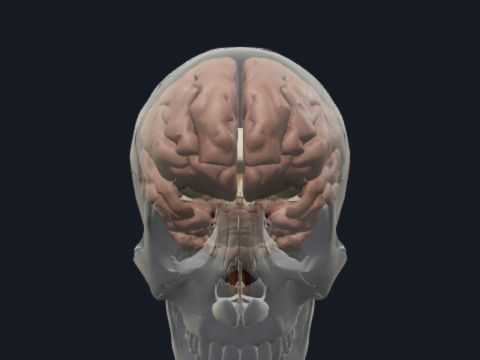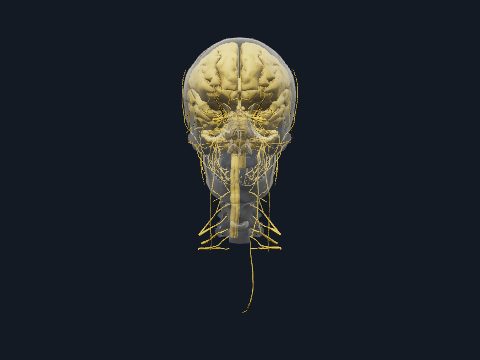
Cranial nerves in 3D
The cranial nerves are 12 pairs of nerves that attach to the central nervous system and leave through foramina in the skull, numbered I to XII from front to back. They carry smell, vision, hearing, balance and sensation from the face, supply the muscles of the eye, face, jaw, tongue, pharynx and larynx, and the vagus nerve continues into the thorax and abdomen. In this free 3D model you can see where the nerves attach to the brain and follow their branches inside a see-through skull.
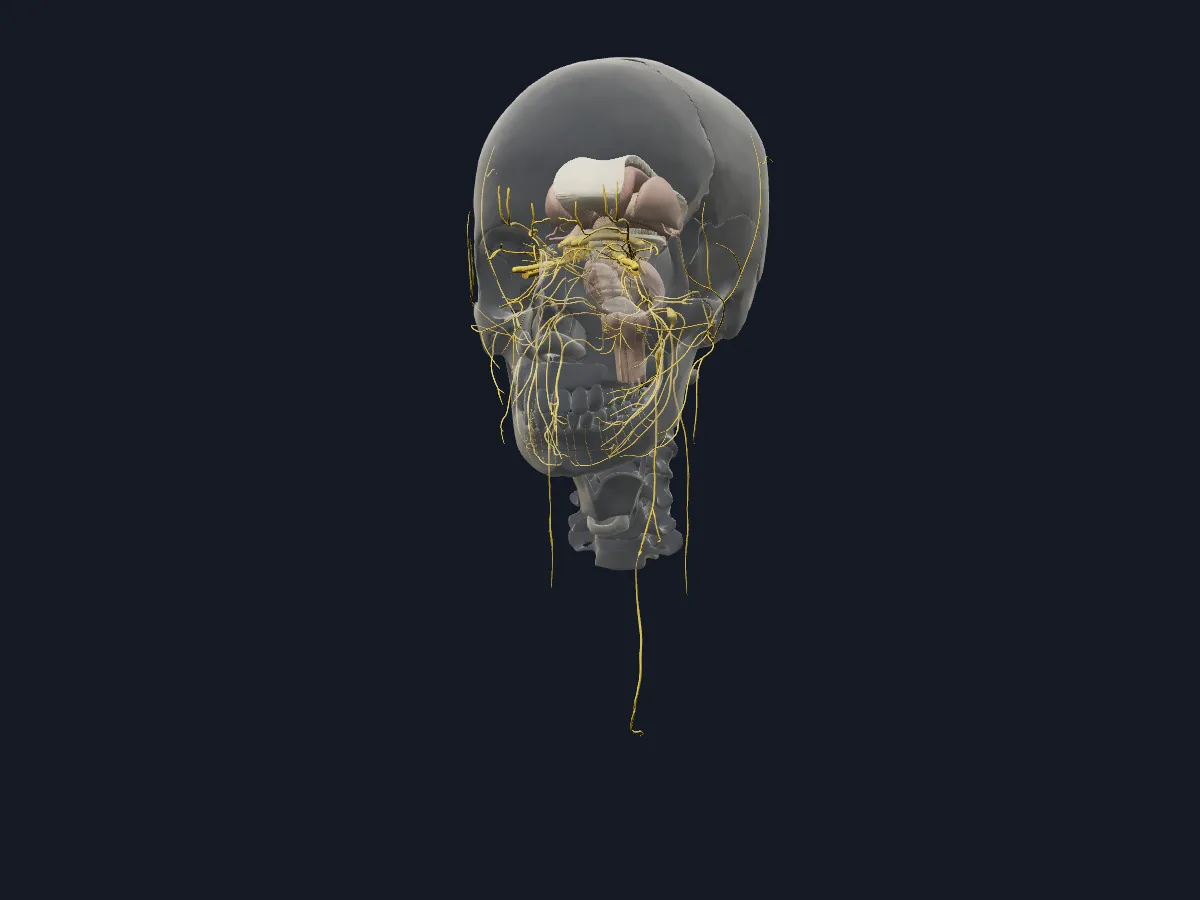 Image: Cogni Anatomy · CC BY-SA 4.0 · Sources: BodyParts3D, Z-Anatomy
- 12 pairs, numbered I–XII in order of their attachment from front to back
- I (olfactory) and II (optic) attach to the forebrain. Most cranial nerves attach to the brainstem; the spinal part of the accessory nerve (XI) arises from the upper cervical spinal cord.
- 3 nerves are purely sensory: I, II and VIII
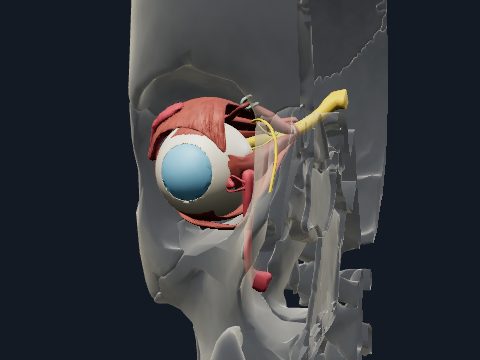
- The lateral rectus is supplied by VI, the superior oblique by IV, the other extraocular muscles by III
- The trochlear nerve (IV) is the only cranial nerve that leaves the dorsal side of the brainstem
Functions and origins
The olfactory (I), optic (II) and vestibulocochlear (VIII) nerves are sensory. The oculomotor (III), trochlear (IV) and abducens (VI) nerves move the eye, and the accessory (XI) and hypoglossal (XII) nerves are motor to neck and tongue muscles. The trigeminal (V), facial (VII), glossopharyngeal (IX) and vagus (X) nerves are mixed.
III and IV leave the midbrain, V the pons, VI, VII and VIII the junction of the pons and medulla, and IX, X and XII the medulla oblongata. III, VII, IX and X also carry parasympathetic fibres.
What the 3D model shows
The cranial nerves view has 108 parts, with the brainstem, thalamus and basal nuclei as landmarks and the skull faded around them. It shows the olfactory nerve, the optic nerve, chiasm and tract, the oculomotor nerve with its superior and inferior branches and the ciliary ganglion, and the trochlear and abducens nerves. The trigeminal nerve appears with its sensory and motor roots and the ophthalmic, maxillary and mandibular divisions with their branches. The facial, vestibulocochlear, glossopharyngeal, vagus and hypoglossal nerves complete the view.
How to study the cranial nerves
Turn to the inferior view and read the attachments from front to back: optic chiasm, oculomotor nerves beside the midbrain, the trigeminal on the side of the pons, then the nerves at the pontomedullary junction and on the medulla. Isolate the trochlear nerve and rotate to see it wind around the midbrain. Follow the trigeminal divisions and the optic nerve forwards towards the orbit. Then search each nerve by name, hide the rest, and test yourself: number, name, sensory, motor or mixed.
What is in this model
108 3D parts. Names follow the Foundational Model of Anatomy (FMA).
- Nerves 108
- Abducens nerve (VI)
- Anterior division of mandibular nerve
- Anterior ethmoidal nerve
- Buccal nerve
- Caudate nucleus
- Ciliary ganglion
- Communicating branch of left nasociliary nerve with left ciliary ganglion
- Communicating branch of right nasociliary nerve with right ciliary ganglion
- Corpus callosum
- Facial nerve (VII)
- Frontal nerve
- Globus pallidus
- Glossopharyngeal nerve (IX)
- Hypoglossal nerve (XII)
- Hypothalamus
- Inferior alveolar nerve
- Inferior branch of left oculomotor nerve
- Inferior branch of right oculomotor nerve
- Inferior colliculus
- Infratrochlear nerve
- Lacrimal nerve
- Lateral geniculate body
- Lingual nerve
- Long ciliary nerve
- Maxillary nerve
- Medial geniculate body
- Medulla oblongata
- Meningeal branch of maxillary nerve
- Mental nerve
- Midbrain
- Motor root of trigeminal nerve
- Nasociliary nerve
- Nerve to mylohyoid muscle
- Oculomotor nerve (III)
- Olfactory nerve (I)
- Ophthalmic nerve
- Optic chiasm
- Optic nerve
- Optic tract
- Peduncle of midbrain
- and 17 more
Questions
How many cranial nerves are there?
12 pairs: olfactory, optic, oculomotor, trochlear, trigeminal, abducens, facial, vestibulocochlear, glossopharyngeal, vagus, accessory and hypoglossal.
Which cranial nerves are purely sensory?
The olfactory (I), optic (II) and vestibulocochlear (VIII) nerves, which carry smell, vision, and hearing and balance.
Which cranial nerve has the widest distribution?
The vagus nerve (X). It leaves the skull through the jugular foramen and runs through the neck and thorax into the abdomen, supplying the pharynx, larynx, heart, lungs and much of the gut.