Human muscles in 3D
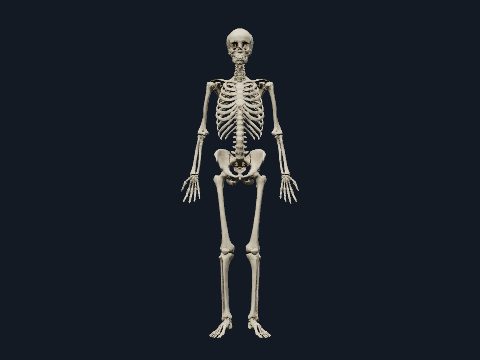
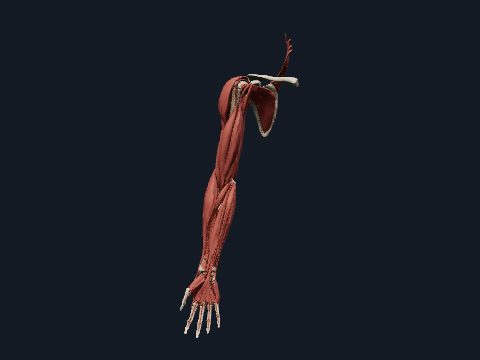
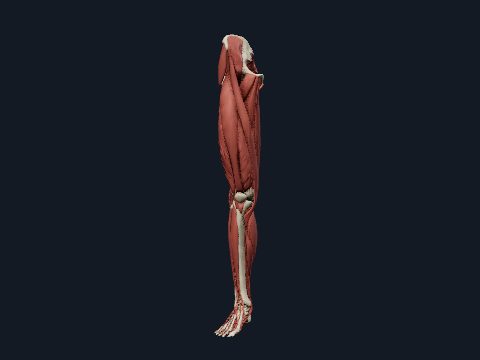
The muscular system is made up of more than 600 skeletal muscles that move the bones, maintain posture and produce heat. Muscles attach to bones through tendons and act across joints, usually in groups with opposing actions. In this free 3D model you can see the muscles of the whole body on the skeleton, remove them layer by layer and isolate any muscle to see where it attaches.
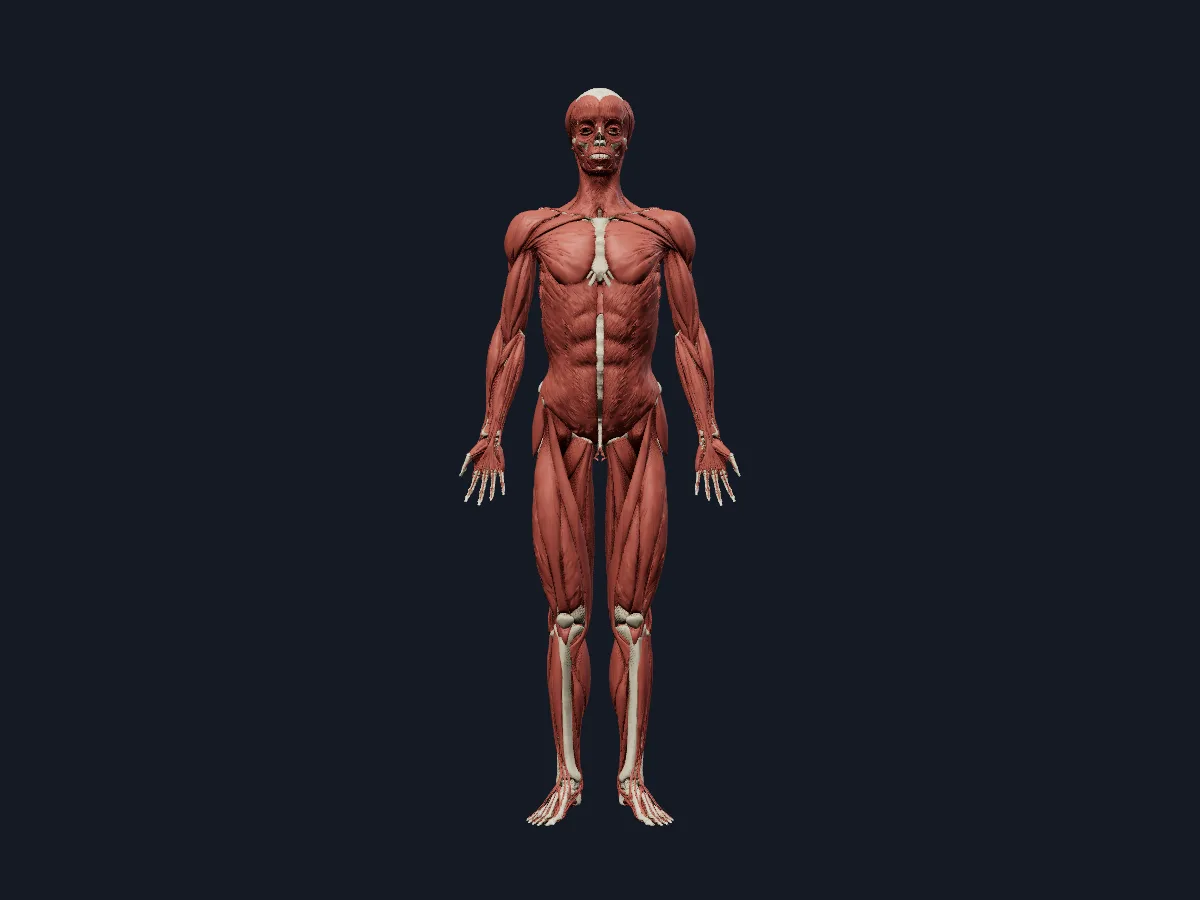 Image: Cogni Anatomy · CC BY-SA 4.0 · Sources: BodyParts3D, Z-Anatomy
- More than 600 skeletal muscles in the human body
- 3 types of muscle tissue: skeletal, cardiac and smooth
- Gluteus maximus is the largest muscle; stapedius in the middle ear is the smallest
- Sartorius, running from the pelvis to below the knee, is the longest muscle
- The diaphragm is the main muscle of breathing
How the muscular system is organised
Each skeletal muscle has an origin, usually the more fixed attachment, and an insertion on the bone it moves. The muscle that produces a movement is the agonist, the one that opposes it the antagonist, and synergists and fixators steady the joints involved. Biceps brachii and triceps brachii at the elbow are the classic pair.
By region, the head has the muscles of facial expression and mastication; the neck holds sternocleidomastoid, the scalenes and the hyoid muscles; the trunk has the back muscles, the intercostals and the diaphragm; and the limbs have muscles grouped in compartments by function and nerve supply.
What the 3D model shows
The model shows the muscles of the whole body on both sides, set on the full skeleton: the facial and masticatory muscles, the extra-ocular muscles, the muscles of the tongue, palate, pharynx and larynx, the neck muscles and the deep muscles of the back, the intercostals, diaphragm and external oblique, the pelvic floor, and the muscles of the shoulder, arm, hand, hip, leg and foot. Muscle layers let you remove the superficial muscles to reveal the deeper ones underneath.
How to study the muscles
Work region by region rather than all at once. Pick a region, start with the superficial layer in the anterior view, then turn to the posterior view. For each muscle, name its origin, insertion, action and nerve, then hide it and see what lies beneath. Use the search to jump to a muscle you keep confusing with a neighbour and isolate it to see both attachments. Then close the model and recall the layers in order; repeating that recall over several days works far better than rereading.
What is in this model
778 3D parts. Names follow the Foundational Model of Anatomy (FMA).
- Muscles 498
- Bones 280
- Abdominal part of left pectoralis major
- Abdominal part of right pectoralis major
- Abductor digiti minimi of left foot
- Abductor digiti minimi of left hand
- Abductor digiti minimi of right foot
- Abductor digiti minimi of right hand
- Abductor hallucis
- Abductor pollicis brevis
- Abductor pollicis longus
- Acromial part of left deltoid
- Acromial part of right deltoid
- Adductor brevis
- Adductor longus
- Adductor magnus
- Adductor minimus
- Anconeus
- Anterior belly of digastric muscle
- Anterior papillary muscle of right ventricle
- Anterolateral head of lateral papillary muscle of left ventricle
- Ary-epiglottic part of oblique arytenoid muscle
- Aryepiglotticus
- Arytenoid cartilage
- Ascending part of left trapezius
- Ascending part of right trapezius
- Atlas
- Axis
- Body of sternum
- Brachialis
- Brachioradialis
- Buccinator
- Calcaneus
- Capitate
- Cervical rotator
- Clavicle
- Clavicular part of left deltoid
- Clavicular part of left pectoralis major
- Clavicular part of right deltoid
- Clavicular part of right pectoralis major
- Coccygeus
- Coracobrachialis
- and 456 more
Questions
How many muscles are in the human body?
More than 600 skeletal muscles; the exact number depends on how paired muscles and muscle parts are counted. Smooth and cardiac muscle are not counted in this total.
What are the three types of muscle?
Skeletal muscle, which is voluntary and moves the bones; cardiac muscle, which forms the wall of the heart; and smooth muscle, which lines hollow organs and blood vessels. Skeletal and cardiac muscle are striated, smooth muscle is not.
Is this 3D muscle model free?
Yes. The muscle model and the rest of the atlas are free to use in the browser, without an account.